
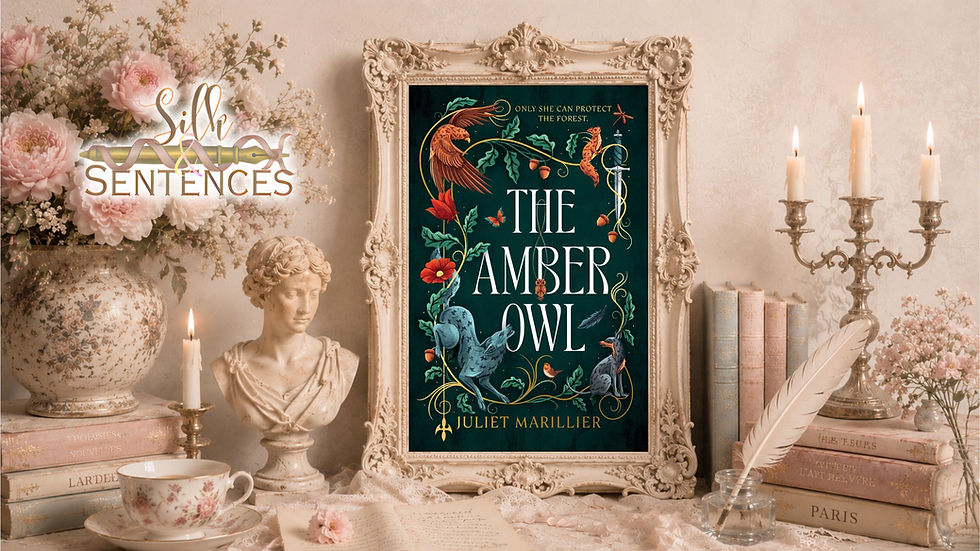
Juliet Marillier has been one of my favourite authors for decades. I've followed her work across much of my reading life and proudly collect every book she publishes. Few writers evoke the ancient intelligence of forests, the enduring power of folklore and the courage of socially isolated characters with such conviction. Opening The Amber Owl returned me to the qualities that first made her novels so important to me while introducing a world with its own distinctive magic.
Set beside the ancient Heartwood Forest, the novel follows Stasya, a young woman who lives alone beyond the village boundary. Raised by her grandmother, she possesses an extraordinary sensitivity to animals and experiences their distress through impressions and images. Her ability makes her useful to the villagers, although it's never secured her acceptance among them.
Stasya is direct, solitary and frequently uncertain of the social rules governing other people’s behaviour. Animals make sense to her in ways that humans often don't. Her closest companions are Lukas, a young goatherd who shares her love of stories, and Flip, a small and decidedly unusual creature whose true nature is gradually revealed.
Their quiet existence is disrupted by the arrival of Commander Rihard and his soldiers. Acting under orders from Lady Elisabeta, Ruler of the Northlands, they intend to cut a road through Heartwood Forest in search of amber believed to possess unusual powers. The village men are forced to fell trees while the remaining community have to support both themselves and the occupying soldiers.
For Lady Elisabeta, the forest is an impediment standing between her and a coveted resource. Stasya understands it as a living community carrying its own histories, laws and forms of knowledge. The conflict between these two ways of seeing the land gives the novel its moral urgency.
Stasya possesses the qualities I've always admired in Marillier’s protagonists. She's observant and compassionate without being sentimental. Her gentleness never diminishes her resolve. When confronted by cruelty, coercion and political authority, she remains guided by an unwavering knowledge of what she believes is right.
Her heroism grows from attentiveness. She listens to animals, remembers her grandmother’s teachings and recognises forms of suffering that others have learned to ignore. She doesn't need to dominate her surroundings in order to influence them. Her strength emerges through care, patience and refusal.
Marillier has described Stasya as a character she views as being on the autism spectrum, although the world of the novel doesn't have any language through which to identify her in those terms. This understanding gives particular weight to Stasya’s isolation and to the assumptions other people make about her. Her difference is never treated as a flaw awaiting correction. The same qualities that separate her from village society also allow her to perceive dangers and connections that remain invisible to others.
Her journey gradually challenges the idea that belonging has to be earned through conformity. Stasya doesn't become worthy of community by learning to imitate everybody else. Instead, the people travelling beside her begin to recognise the value of her particular way of understanding the world.
The widening political stakes never overwhelm the personal dimensions of the novel. Questions of succession, authoritarian rule and environmental destruction remain connected to individual promises, friendships and acts of betrayal.
Marillier allows conversations, shared tales and tentative alliances to carry as much significance as physical conflict. The pace gives the characters room to change and allows Heartwood to emerge as a place with its own rhythms. I found this deliberate unfolding completely absorbing. The story invites close attention and rewards readers willing to follow its quieter paths.
Longstanding concerns from Marillier’s fiction appear throughout: the survival of old wisdom, humanity’s obligations to the natural world, the strength of outsiders and the creation of community across difference. They feel especially concentrated, where storytelling and environmental guardianship become inseparable.

The Amber Owl reminded me exactly why Juliet Marillier’s books have occupied such a treasured place in my reading life for so long. Her writing combines folkloric beauty with emotional intelligence and a serious moral engagement with the world beyond the page.
Stasya is a memorable heroine whose compassion carries its own authority. Heartwood is rendered with such depth that its threatened destruction feels like an attack upon a living consciousness. The stories woven through the journey enrich the fantasy while asking difficult questions about memory, power and who's permitted to define the truth.
This is an enchanting and deeply thoughtful novel about listening to voices that society has dismissed and protecting forms of life that powerful people consider expendable. It celebrates courage grounded in care and communities strengthened by difference.
Long after I finished reading, I could still feel the hush of Heartwood and the unsettling suggestion that the forest had been listening too.
If only I could permanently live inside a Juliet Marillier novel.

🦉 Read this book if you love atmospheric fantasy steeped in folklore ancient magic and living forests
🌲 Forests that feel like sentient characters filled with memory secrets and hidden paths
🐾 Socially isolated heroines whose empathy for animals becomes a source of extraordinary strength
📖 Stories where folklore preserves forgotten truths inspires resistance and challenges official histories
🌿 Eco-fantasy exploring humanity’s responsibility to nature and the devastating consequences of exploitation
⚔️ Political intrigue involving authoritarian rulers forced labour concealed heirs and contested legitimacy
🫶 Found families formed through shared danger gradual trust and respect for one another’s differences
✨ Lyrical thoughtful adventures celebrating quiet courage compassionate outsiders and the enduring power of storytelling
Book Details
The Amber Owl by Juliet Marillier
Paperback ISBN
978-1763662513 — New Dawn Australian and New Zealand trade paperback edition published on 25 February 2025
978-1837867721 — Solaris United Kingdom and international paperback edition published on 16 July 2026
Hardcover ISBN
No ISBN is currently displayed in the publisher’s public catalogue for the New Dawn Australian special-edition hardback published on 15 August 2025
eBook ISBN
978-1763662520 — New Dawn Australian and New Zealand eBook edition
978-1837867738 — Solaris United Kingdom and international eBook edition published on 16 July 2026
Audiobook ISBN
978-1038018458 — Bolinda Publishing Australian and international unabridged digital audiobook edition
978-1038049599 — Bolinda Publishing international unabridged digital audiobook edition released on 1 December 2025
Genre
Historical Fantasy; Folkloric Fantasy; Eco-Fantasy; Epic Fantasy; Young Adult Fantasy; Adult Fantasy
Subgenre
Forest Fantasy; Quest Fantasy; Political Fantasy; Nature-Centred Fantasy; Fairy-Tale and Folklore Fantasy; Character-Driven Fantasy; Neurodivergent Fantasy; Environmental Fantasy
Tropes / Literary Threads
Outsider heroine; ancient sentient forest; animal affinity; shapshifting animal companion; oppressive ruler; forced labour; captivity and escape; storytelling as resistance; hidden heir; contested succession; found family; unlikely allies.
Publisher
New Dawn Publishing — Australia and New Zealand
Solaris — United Kingdom and international markets
Simon & Schuster — Australian and United Kingdom distribution
Bolinda Publishing — audiobook
Series
The Heartwood Duology — Book One
Formats Available
Trade Paperback; Special-Edition Hardcover; eBook; Digital Audiobook
Audiobook Narrator
Emma Drysdale
Audiobook Length
Approximately 15 hours 8 minutes
Original Release Date
25 February 2025 — New Dawn Australian and New Zealand trade paperback and eBook editions
16 April 2025 — Bolinda unabridged digital audiobook edition
15 August 2025 — New Dawn Australian special-edition hardback
16 July 2026 — Solaris United Kingdom and international paperback and eBook editions
Australian Release Date
25 February 2025 — Australian trade paperback and eBook editions
16 April 2025 — Australian unabridged digital audiobook edition
15 August 2025 — Australian special-edition hardback
Page Count
416 pages — Australian and New Zealand trade paperback ISBN 978-1763662513
416 pages — Australian special-edition hardback
416 pages — United Kingdom and international Solaris paperback ISBN 978-1837867721
Where to Buy The Night We Met by Abby Jimenez
📚 Amazon
Affiliate Disclosure
As an Amazon Associate, I earn from qualifying purchases. If you purchase through my Amazon affiliate links, I may receive a small commission at no additional cost to you. I also encourage supporting Australian booksellers such as QBD Books, independent booksellers, and self-published authors whenever possible.


Danielle Robinson is a literary critic and writer whose
work explores literature through the
lens of atmosphere, memory, culture, and emotional experience. Holding a double degree in philosophy and theology, she combines academic insight with a deeply refined aesthetic sensibility shaped by more than three decades working across the creative industries as an internationally published, multi-award-winning makeup artist, fashion stylist, and interior stager.
She reads widely and rigorously, reading and reviewing more than 200 books each year as both an ARC reader and commissioned critic. Through Silk & Sentences, Danielle approaches literature as something immersive and lived with — not simply stories to consume, but works that shape the way we think, feel, and move through the world.
She writes from her semi-rural Queensland home, where she lives with Alex, her husband of 33 years, their dogs Oscar and Paige, and an ever-growing library of books.

You’ve answered so many of my questions about this book, Danielle. Thanks so much.