
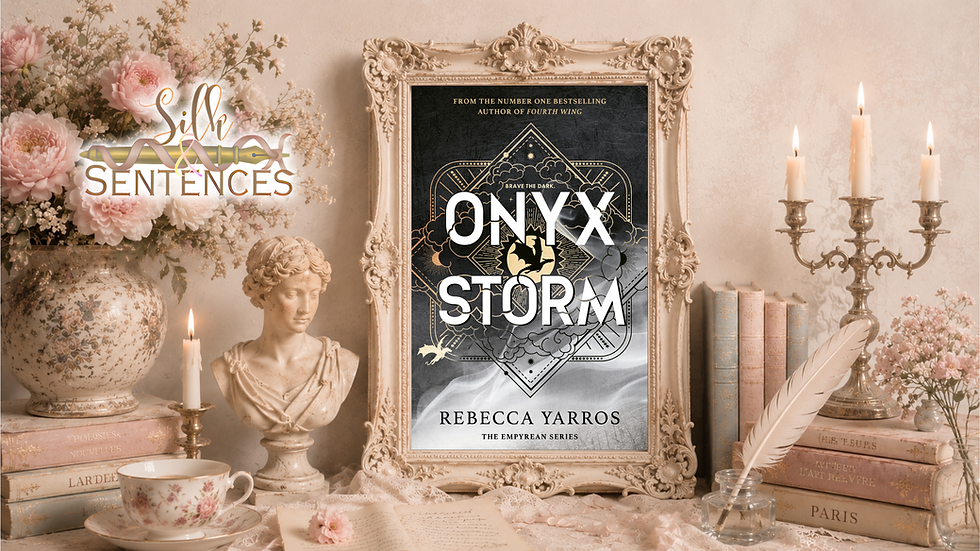

Onyx Storm is the first Empyrean novel that convinced me Rebecca Yarros had moved beyond the sheer momentum of her premise and begun exploring the more interesting possibilities within the world she created.
I found Fourth Wing compulsively readable but uneven, and Iron Flame larger without necessarily being better. Both had dragons, danger, sexual tension and cliffhangers engineered with ruthless efficiency, but neither fully persuaded me that the political structure, magical history and emotional stakes could support the weight being placed upon them.
Onyx Storm is different. It's still excessive. It remains melodramatic, occasionally repetitive and so overloaded with revelations that several of them barely have time to settle before the next catastrophe arrives. Yet it's also more ambitious, more morally complicated and much better at allowing romance, warfare, friendship and political power to affect one another.
This is the third novel in Yarros’s planned five-book Empyrean series and shifts the story beyond the relatively contained world of Basgiath War College. The official categorisation remains fantasy romance, but the novel leans much further into military fantasy, political negotiation and quest narrative than its predecessors.
That shift worked for me.
This review discusses the entire novel, including Violet’s second signet, the irids, Andarna’s departure, Theophanie’s identity, Xaden’s progression and the final revelations involving Violet’s marriage and missing memories.
The book also contains graphic violence, severe injuries, death, poisoning, war and explicit sexual content.
Dream-Walking and the Danger of Knowing Too Much
Violet’s second signet is dream-walking, an ability inherited through her bond with Andarna. She can enter another person’s dreams while their mental shields are lowered, initially experiencing the dream through their eyes and later moving through it independently.
It suits Violet perfectly. Her defining hunger has never been for physical dominance. It's for information.
Yet dream-walking isn't simply a convenient extension of her intelligence. It 's a profound threat to privacy and consent. Violet has spent the series opposing an institution that conceals information from its citizens. She now possesses the power to enter someone’s most vulnerable mental space without permission.
That makes her ability potentially more dangerous than lightning. Lightning can kill a body. Dream-walking could expose secrets, alter perceptions or access fears a person has never consciously admitted.
It also destabilises the idea of truth. Dreams aren't archives. They combine memory, trauma, fear, desire and external manipulation. Violet may be able to witness what someone dreams, but that doesn't mean she can treat it as objective evidence.
Yarros has therefore given her truth-seeking heroine a power that may ultimately make truth harder to define.
The Difference Between a Cure and Redemption
Violet spends much of the novel treating two questions as though they are identical:
Can Xaden’s venin transformation be cured?
Can Xaden still be redeemed?
They aren't the same.
A cure would reverse or arrest a magical condition. Redemption would require Xaden to retain moral agency, take responsibility and make ethical choices despite what has happened to him.
The irids insist that each act of channeling destroys a portion of the soul and that what has been lost can't be restored. Violet interprets this as evidence that Xaden is moving beyond salvation.
I'm not convinced the irids should be treated as unquestionable authorities. They may understand the magical process perfectly while knowing very little about human identity. Their belief that a lost piece of the soul makes redemption impossible is also consistent with their broader moral detachment. They're willing to watch entire populations die rather than participate in war. Their knowledge is ancient, but their compassion is limited.
Xaden may never become precisely who he was before he channelled. That doesn't automatically determine who he can choose to be afterwards.
The more interesting direction for the series may not be a clean cure. It may be a story about whether a damaged identity can remain morally responsible without ever becoming whole again.
Andarna and the Ethics of Loving What We Use
Andarna has the most painful arc in the novel. Violet loves her. Tairn loves her. The other dragons have protected her. Yet the irids aren't entirely wrong when they accuse Violet and her allies of helping turn Andarna into a weapon.
Andarna is proud of her strength. She chose her scorpiontail and wants to fight. She believes courage means sharpening her claws against the enemy. When the irids recoil from what she's become, she hears their disapproval as confirmation that she's broken.
Her distress exposes how thoroughly the values of war have shaped her understanding of worth.
The irids describe themselves as dragons of peace, but their position is hardly pure. Their refusal to intervene would allow humans and dragons to be slaughtered by the venin. They condemn the use of magic as a weapon while remaining protected from the consequences of everyone else’s war.
Andarna is therefore caught between two imperfect communities:
one loves her but has taught her to define herself through combat;
the other shares her nature but rejects the person she has become.
Her decision to leave with Leothan isn't a rejection of Violet. It's an assertion that she needs an identity beyond her bond with Violet.
The revelation that an irid can voluntarily break a rider bond also changes the meaning of every dragon–rider relationship in the series. What has been treated as sacred and permanent may also contain an element of magical compulsion.
Violet’s response is relevant. She doesn't command Andarna to stay or make her responsible for Violet’s grief. She gives her permission to choose.
When Andarna returns during the confrontation with Theophanie, she does so without the bond forcing her. She returns because she wants to. That voluntary return may be more meaningful than their original connection.
Knowledge Has Always Been the Real Battlefield
The deeper conflict within the Empyrean series has never been fought solely between riders and venin. It has been fought over information.
Onyx Storm contains:
censored histories;
missing military records;
locked books;
private journals;
secret signets;
hidden identities;
dream intrusion;
memory reading;
memory erasure;
coded research;
politically controlled archives.
Navarre’s foundational crime is historical manipulation. Its leaders don't merely refuse to help neighbouring territories. They erase the existence of the threat and manufacture a false national history to justify their isolation.
Violet’s father responds by hiding information inside puzzles that only his daughter can solve. This protects his work, but it also allows him to control when and how Violet learns the truth. Violet then repeats the pattern.
She withholds Xaden’s condition. She keeps her second signet secret. She eventually asks Imogen to remove twelve hours from her own memory.
The series began with Violet believing that knowledge would free her from institutional control. Onyx Storm complicates that faith. Information can liberate, but it can also endanger, manipulate and destroy. Sometimes survival may depend upon not knowing.
Memory Erasure and the Question of Consent
The ending leaves Violet outside Riorson House with no memory of the previous twelve hours.
She discovers that she's legally married to Xaden. She's wearing an emerald ring. Xaden has disappeared. Dragon eggs are missing. Riders and dragons are dead or unaccounted for. Imogen confirms that she erased Violet’s memories because Violet instructed her to do so.
This is a superbly unsettling development because Violet’s earlier self has made a decision her present self can't examine.
The marriage may be legally valid. Violet may have consented enthusiastically at the time. Yet the Violet who awakens can't remember the ceremony, the reason for it or the circumstances surrounding it.
Her present self is expected to trust a version of herself who possessed information she deliberately chose to destroy.
This creates a philosophical fracture within Violet’s identity. Does she owe loyalty to a decision made by her former self when she can no longer access that self’s reasoning? Is consent continuous when the memory of giving it has been removed? Can a person meaningfully inherit obligations from a self they have intentionally made inaccessible?
The cliffhanger is romantic on the surface, but its real force comes from these questions.
The Marriage Is Almost Certainly Political
Xaden and Violet’s wedding is unlikely to have been motivated by romance alone.
By marrying Xaden, Violet becomes Duchess of Tyrrendor. If Xaden is exposed as venin, declared a traitor or believed dead, Tyrrendor still has a legally recognised ruler.
The marriage may allow Violet to:
command Tyrrendor’s military and political resources;
protect the province from being reclaimed by Navarre;
control whatever Xaden has transferred to her;
provide continuity if Bodhi or other heirs are compromised;
act independently of King Tauri and Halden.
The emerald in her ring links the marriage to the Blade of Aretia and therefore to Tyrrendor’s political inheritance. It isn't simply a romantic ornament. It's an emblem of territorial authority.
Rebecca Yarros has said that the novel’s final line had been in her mind since she wrote the original synopsis for Fourth Wing. That indicates the marriage and memory twist were embedded in the longer series plan rather than introduced merely to produce a shocking ending.
A Supporting Cast That Finally Feels Essential
One of the greatest improvements in Onyx Storm is that Violet’s friends are no longer present merely to provide banter, information or emotional reactions.
Ridoc
Ridoc becomes the person willing to challenge Violet’s refusal to establish a boundary with Xaden. His humour has caused others to underestimate him, but he proves emotionally perceptive, fiercely loyal and entirely serious when Violet’s safety is involved.
He doesn't protect her by agreeing with her.
Rhiannon
Rhiannon represents a less dramatic and arguably more sustainable form of leadership. Violet herself recognises that Rhiannon may be the strongest among them—not because she possesses the most spectacular signet but because she understands collective responsibility.
Sawyer
Sawyer’s return to riding after losing part of his leg is handled through adaptation rather than miraculous restoration. He and Sliseag must change their method. Sawyer’s strength lies partly in accepting assistance and abandoning the belief that competence must look exactly as it did before his injury.
Dain
Dain’s redemption continues through action rather than apology. He retrieves Violet’s father’s research, opposes his father’s authority and allows Sloane to siphon power from him to save Mira.
He can't undo Liam’s death. The novel doesn't pretend otherwise. He can only continue making different choices.
Cat
Cat is allowed to become more than Xaden’s former betrothed. Her growing closeness with Violet and her feelings for Trager expand her beyond romantic rivalry.
Trager’s death humanises her, although it also reveals one of the novel’s weaknesses: he receives just enough emotional development for his death to wound Cat and horrify the reader before the plot moves on.
Aaric
Aaric’s precognition positions him as a major political figure for the remaining books. His power isn't merely useful in battle. It may allow him to challenge the leadership of his father and brother with knowledge of the consequences they can't see.
Where Onyx Storm Stumbles
The novel is better than its predecessors, but it's not more disciplined. Its greatest weakness is accumulation. New kingdoms, gods, prophecies, signets, dragon histories, political claims and betrayals continue arriving until the book begins to feel as though every mystery is reproducing faster than the characters can solve them.
The middle quest is exciting but episodic. Emotional consequences are repeatedly shortened because the next danger is already waiting. Trager dies, the squad grieves and the mission resumes. Andarna leaves, Violet collapses for several days and war immediately demands her attention. Quinn dies during an already crowded battle filled with shifting perspectives and simultaneous revelations.
The speed preserves momentum but reduces the emotional weight of events that deserve more space.
The romantic scenes can also become repetitive. Xaden and Violet desire one another, fear he will channel, test his control, succeed temporarily and then return to the same danger. The repetition makes thematic sense, but not every version adds enough to justify its length.
Finally, the ending withholds almost everything at once:
Violet’s wedding;
the erased twelve hours;
Xaden’s disappearance;
the missing dragon eggs;
Garrick’s absence;
the unidentified new venin;
murdered riders and dragons;
an unexplained transfer of power.
The shock is effective. The frustration is equally deliberate. At some point, a series must provide satisfaction as well as anticipation. Onyx Storm comes closer than Iron Flame because it completes several emotional developments—particularly Andarna’s decision and Theophanie’s defeat—but it remains heavily dependent on the promise that later books will make its mysteries worthwhile.
Why This Worked Better for Me Than Fourth Wing and Iron Flame
Fourth Wing had a terrific premise and an irresistible reading rhythm, but its world frequently felt designed around its central romance rather than existing beyond it.
Iron Flame expanded the conspiracy and magical history, yet its structure was uneven and Violet and Xaden’s communication problems became exhausting. The plot grew while the emotional conflict circled familiar ground.
Onyx Storm finally allows the different parts of the series to reinforce one another.
The romance affects military strategy. Dragon bonds raise questions of autonomy. Political alliances demand personal sacrifices. Magical abilities create ethical problems rather than functioning only as exciting weapons. Violet’s intelligence influences the plot as substantially as her lightning. Xaden’s corruption becomes psychologically understandable without being excused.
The novel also gives the supporting characters more authority. Violet remains central, but the story no longer argues that she must personally be the best person for every task. Her ability to recognise Rhiannon’s leadership, accept Ridoc’s challenge and rely on Sloane, Dain, Brennan, Mira and Aaric makes her more convincing as a future ruler.
This is still unapologetically commercial fantasy. Yarros writes for momentum, emotion and reader reaction. The dialogue is modern, the romantic intensity is extravagant and the cliffhangers know exactly what they're doing.
Yet Onyx Storm is also the first book in the series where I found the ideas nearly as interesting as the propulsion.
Onyx Storm succeeds because victory and loss become increasingly difficult to distinguish.
Violet finds the irids but not the cure. She saves Andarna by allowing her to leave. She kills Theophanie but can't prevent Xaden’s further transformation. She becomes Duchess of Tyrrendor but can't remember choosing the title or the marriage that gave it to her. She acquires greater knowledge throughout the novel and ends by deliberately surrendering the knowledge she needs most.
Xaden’s tragedy is equally precise. Love remains the final piece of his humanity, yet love is also the reason he repeatedly reaches for the power destroying him. He can't protect the people he loves without becoming less capable of loving them.
The final image isn't simply Violet abandoned with a wedding ring. It's Violet confronted by proof that an earlier version of herself knew the truth and decided she couldn't be trusted to remember it. That's a far more interesting danger than another wyvern at the gates.
Book Details
Onyx Storm — Rebecca Yarros
Paperback ISBN
978-0349443768 — Piatkus Australian trade paperback edition published in 2025
978-0349437095 — Piatkus standard paperback edition published in 2026
Hardcover ISBN
978-0349443775 — Piatkus Australian hardcover edition published in 2025
eBook ISBN
978-0349443249 — Little, Brown Book Group / Piatkus Australian eBook edition
Audiobook ISBN
978-1705085110 — Recorded Books unabridged digital audiobook edition
Genre
Fantasy Romance; New Adult Fantasy; Epic Fantasy; Romantic Fantasy.
Rebecca Yarros’s official listing categorises the novel as Fantasy Romance and Romance, while the broader narrative incorporates epic fantasy, military fantasy and political fantasy elements.
Subgenre
Dragon-Rider Fantasy; Military Fantasy; Quest Fantasy; Political Fantasy; Adventure Fantasy; Dark Fantasy; High-Stakes Romantasy
Tropes / Literary Threads
Established couple under threat; dragon riders; forbidden dark magic; hero battling magical corruption; dangerous cure quest; found family; chosen family; political alliances; royal intrigue; hidden histories; suppressed knowledge; secret signets.
The novel follows Violet’s expedition beyond Navarre’s failing wards as she searches for allies, the missing seventh breed of dragons and a possible way to save Xaden from his venin transformation. Its central concerns include love and moral judgement, redemption, kinship, political bargaining, sacrifice, memory and the ethics of power.
Publisher
Piatkus — Little, Brown Book Group / Hachette Australia — Australian trade paperback, hardcover, standard paperback and eBook editions
Red Tower Books — Entangled Publishing — original United States editions
Recorded Books Inc. — unabridged digital audiobook edition
Series
The Empyrean
Series Order
Book Three
Fourth Wing
Iron Flame
Onyx Storm
The forthcoming Threshing Day is a companion collection set within the Empyrean world rather than the fourth principal Violet Sorrengail novel. Yarros’s official listing identifies Onyx Storm as Empyrean Book Three.
Formats Available
Trade Paperback; Standard Paperback; Hardcover; eBook; Unabridged Digital Audiobook
No Australian physical CD or MP3 audiobook edition is currently listed by Hachette Australia. The standard audiobook available through Australian retailers is the Recorded Books digital edition.
Audiobook Narrators
Rebecca Soler; Teddy Hamilton; Jasmin Walker; Justis Bolding
Audiobook Length
23 hours 52 minutes 40 seconds — unabridged digital audiobook
Original Release Date
21 January 2025 — Red Tower Books United States edition
Australian Release Date
21 January 2025 — Piatkus Australian trade paperback, hardcover and eBook editions
21 January 2025 — Recorded Books digital audiobook edition
24 March 2026 — Piatkus standard paperback edition
Page Count
544 pages — Piatkus Australian trade paperback edition
544 pages — Piatkus Australian hardcover edition
544 pages — Little, Brown Book Group Australian eBook edition
672 pages — compact standard paperback edition published in 2026
Where to Buy Onyx Storm by Rebecca Yarros
Affiliate Disclosure
As an Amazon Associate, I earn from qualifying purchases. If you purchase through my Amazon affiliate links, I may receive a small commission at no additional cost to you. I also encourage supporting Australian booksellers such as QBD Books and independent booksellers whenever possible.


Danielle Robinson is a literary critic and writer whose
work explores literature through the
lens of atmosphere, memory, culture, and emotional experience. Holding a double degree in philosophy and theology, she combines academic insight with a deeply refined aesthetic sensibility shaped by more than three decades working across the creative industries as an internationally published, multi-award-winning makeup artist, fashion stylist, and interior stager.
She reads widely and rigorously, reading and reviewing more than 200 books each year as both an ARC reader and commissioned critic. Through Silk & Sentences, Danielle approaches literature as something immersive and lived with — not simply stories to consume, but works that shape the way we think, feel, and move through the world.
She writes from her semi-rural Queensland home, where she lives with Alex, her husband of 33 years, their dogs Oscar and Paige, and an ever-growing library of books.

I was undecided about trying this series, and you’ve convinced me that it might not be for me. Thank you for saving me the time!