
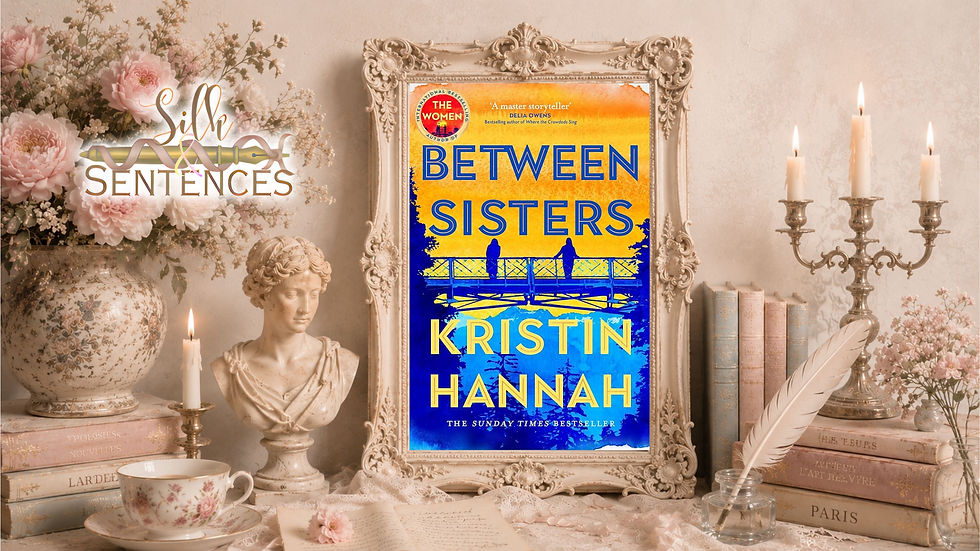

Meghann Dontess can dismantle a marriage before lunch, stare down an abusive husband by mid-afternoon and still have no idea how to speak honestly to her own sister.
That contradiction is the most compelling element of Kristin Hannah’s Between Sisters. Meg is brilliant when another woman’s life is collapsing. She knows which questions to ask, which financial records to examine and precisely how hard to push. Yet when it comes to Claire, who's the little sister she once protected and later abandoned, Meg’s confidence gives way to defensiveness, judgement and a particularly exhausting belief that being right is the same thing as being loving.
Originally published in 2003, Between Sisters belongs to an earlier stage of Hannah’s career, before the historical scale of The Nightingale, The Four Winds and The Women.
The emotional architecture is already recognisably hers: damaged women, buried family history, fierce love expressed through sacrifice and a crisis designed to strip every character of their carefully maintained defences.
The novel contains much of what Hannah does well. It also contains several of her more frustrating habits in concentrated form. The character psychology is often perceptive. The emotional stakes are high. The relationships have genuine warmth. Yet the plot becomes increasingly reliant on coincidence, medical melodrama and resolutions that arrive more neatly than the pain preceding them deserves.
Meghann Dontess and Competence as Armour
Meg is the strongest character in the novel because she's allowed to be difficult. She's abrasive, judgemental, controlling and often cruel when she feels threatened. She uses money to solve emotional problems. She works punishing hours. She sleeps with younger men and leaves before intimacy can acquire expectations. She's spent four years in therapy while artfully avoiding the one subject her therapist knows she needs to discuss.
She's also brave, loyal, intelligent and capable of extraordinary tenderness. Hannah doesn't present these qualities as contradictions. They all grow from the same wound.
Meg learned early that love meant responsibility. To love Claire was to feed her, protect her and solve whatever disaster their mother had created. She therefore struggles to recognise affection that doesn't take the form of rescue. She can pay for the wedding dress. She can hire a wedding planner. She can find the best medical specialists in the country. She can organise, fund, negotiate and intimidate.
Saying “I was jealous” is much harder. Admitting “I thought you chose him over me” is almost unbearable.
Meg’s professional life reinforces her emotional pessimism. As a family lawyer, she spends every day examining infidelity, abuse, financial deception and the wreckage of failed relationships. Her career offers endless proof that love is unreliable. Better still, it lets her occupy the powerful side of other people’s pain. She's never the bewildered wife at the conference table. She's the person with the strategy.
Her sexual behaviour follows the same pattern. Meg pursues physical contact while controlling the conditions under which it occurs. She selects men unlikely to ask much of her and departs before morning can turn desire into conversation.
She isn't afraid of sex. She's afraid of being known.
That matters when she meets Joe Wyatt.
Eliana and the Limits of Reconciliation
Eliana is one of the few characters who doesn't undergo a redemptive transformation.
She remains theatrical, unreliable and fundamentally unable to place her daughters at the centre of her emotional world. She misses important moments. She turns Claire’s wedding arrival into a performance. Even when Claire becomes seriously ill, Eliana struggles to respond with the maternal depth her daughters need.
Meg and Claire eventually recognise that this is all she can offer. That acceptance is one of the novel’s more honest conclusions. Forgiveness doesn't always produce closeness. Understanding someone’s limitations doesn't make those limitations harmless. A person can release the hope that a parent will change without pretending the neglect no longer matters.
Sam’s apology provides a more satisfying form of accountability. He acknowledges that he failed Meg when she first brought Claire to Hayden. He was overwhelmed and hurt by Eliana’s betrayal, but Meg was still a child. His good intentions towards Claire didn't cancel the damage done to her sister.
The contrast between Eliana and Sam prevents the book from offering a single formula for family repair. One parent can apologise and rebuild. Another may remain incapable. Healing depends on recognising the difference.
Where Between Sisters Succeeds
The novel is at its best when it focuses on the small humiliations and misunderstandings of sisterhood. Meg buying the dress because money's easier than apology. Claire becoming excessively polite when she's furious. The sisters laughing over their mother’s predictable selfishness. Meg discovering that caring for Ali gives pleasure rather than only responsibility. Claire asking Meg not to leave.
These moments work because they understand that family estrangement is rarely sustained by a complete absence of love. More often, love remains present but becomes distorted by pride, shame and incompatible memories.
Meg’s character carries much of the book’s emotional weight. She's neither softened into instant likability nor punished for being ambitious. Her success is real. So is her loneliness. The novel doesn't suggest she chose the wrong life by becoming a lawyer. It suggests that achievement can't substitute for connection when achievement is being used to avoid grief.
Hannah also writes accessible emotional prose. She makes the characters’ motivations clear without requiring readers to decode them from a great distance. For readers who value intimacy and catharsis, that directness is one of the book’s pleasures.
Where It Falls Short
The novel’s largest weakness is its increasing dependence on melodrama.
Claire’s whirlwind romance, sudden music-industry connection, devastating diagnosis, unlikely medical link through Joe and near-miraculous recovery place considerable strain on the otherwise grounded family conflict.
Bobby is lovable but underwritten. Ali is charming but often functions as an emblem of innocence and hope. The Bluesers are engaging but remain mostly collective. Even Joe’s complex moral history is ultimately channelled into the practical function of saving Claire.
The emotional resolutions also arrive with more certainty than the novel’s strongest questions warrant. Joe’s role in Diana’s death raises profound issues around consent, suffering, mercy, law and guilt. The story is more interested in his forgiveness than in examining those issues at length.
Similarly, Meg and Claire’s childhood trauma is given powerful explanation but relatively compressed repair. Their reconciliation is believable as a beginning. The novel often treats it as a completed destination.
I felt the intended emotion. I cared about the sisters. I wanted Claire to survive and Meg to believe herself worthy of love. Yet I remained conscious of how carefully the crisis had been designed to produce those responses.
The heart is sincere, but the machinery's visible.
A Moving Story That Never Fully Escapes Its Contrivances
Between Sisters contains the foundations of the writer Kristin Hannah would become: emotionally wounded women, complicated families, female devotion, sacrifice and the insistence that love is proved by who remains when life becomes unbearable.
It's not her most accomplished novel. The plot leans heavily on coincidence, the romance relies on idealisation and the medical conclusion is too neat for the complexity of the preceding pain.
Yet Meg and Claire’s relationship gives the book substance beyond its melodramatic turns. Their estrangement isn't built on a lack of affection but on two damaged interpretations of the same childhood. Claire believes Meg left because she was no longer loved. Meg left because she believed she was no longer needed.
That misunderstanding is heartbreaking because it's so recognisably human. We often judge ourselves by our intentions and other people by the wound they left behind.
The title refers not only to the bond shared by Meg and Claire but to everything standing between them: Eliana’s neglect, Sam’s mistake, distance, class, jealousy, guilt and twenty-six years of silence. The novel’s most meaningful achievement isn't removing all of those things. It's allowing the sisters to speak across them.
By the end, Meg hasn't simply returned to Claire. She's learned that being a sister isn't the same as being a saviour. Claire's learned that accepting love doesn't make her dependent or selfish. Their reconciliation becomes possible when neither woman needs the other to remain frozen in the role she played as a child.
That emotional insight is strong enough to make the novel affecting, even when the plot surrounding it feels determined to tie every loose end into an exceptionally tidy bow.
Book Details
Between Sisters — Kristin Hannah
Paperback ISBN
978-0345519467 — Ballantine Books US trade paperback edition published in 2009
978-1509835843 — Pan Macmillan Australian trade paperback edition published in 2016
978-1035094875 — Macmillan Australian trade paperback edition published in 2026
Hardcover ISBN
978-0345450739 — original Ballantine Books US hardcover edition published in 2003
eBook ISBN
978-0345464248 — Ballantine Books US eBook edition
978-1925482966 — Macmillan Australian eBook edition
Genre
Contemporary Fiction; Women’s Fiction; Romance
Subgenre
Family Drama; Domestic Fiction; Sibling Fiction; Contemporary Romance; Psychological Fiction; Medical Drama
Tropes / Literary Threads
Estranged sisters; fractured family relationships; childhood abandonment; parentification; sibling reconciliation; opposites in lifestyle and temperament; love at first sight; whirlwind engagement; second-chance romance; grief and bereavement.
Publisher
Ballantine Books — Penguin Random House (United States)
Macmillan — Pan Macmillan Australia (Australia)
Series
Standalone Novel
Meghann Dontess previously appears as a secondary character in Kristin Hannah’s Distant Shores, but the books are not presented as a formal series.
Series Order
N/A
Formats Available
Hardcover; Mass-Market Paperback; Trade Paperback; eBook; Digital Audiobook
Audiobook Narrator
Laural Merlington
Original Release Date
15 April 2003 — Ballantine Books US hardcover edition
Australian Release Date
30 August 2016 — Pan Macmillan Australian trade paperback and eBook editions
10 February 2026 — new Australian Macmillan trade paperback edition
Page Count
400 pages — original Ballantine Books US hardcover edition
480 pages — Ballantine Books US trade paperback and 2016 Pan Macmillan Australian trade paperback editions
448 pages — 2026 Macmillan Australian trade paperback edition
Where to Buy Between Sisters by Kristin Hannah
Affiliate Disclosure
As an Amazon Associate, I earn from qualifying purchases. If you purchase through my Amazon affiliate links, I may receive a small commission at no additional cost to you. I also encourage supporting Australian booksellers such as QBD Books and independent booksellers whenever possible.


Danielle Robinson is a literary critic and writer whose work explores literature through the lens of atmosphere, memory, culture, and emotional experience. Holding a double degree in philosophy and theology, she combines academic insight with a deeply refined aesthetic sensibility shaped by more than three decades working across the creative industries as an internationally published, multi-award-winning makeup artist, fashion stylist, and interior stager.
She reads widely and rigorously, reading and reviewing more than 200 books each year as both an ARC reader and commissioned critic. Through Silk & Sentences, Danielle approaches literature as something immersive and lived with — not simply stories to consume, but works that shape the way we think, feel, and move through the world.
She writes from her semi-rural Queensland home, where she lives with Alex, her husband of 33 years, their dogs Oscar and Paige, and an ever-growing library of books.


Comments