
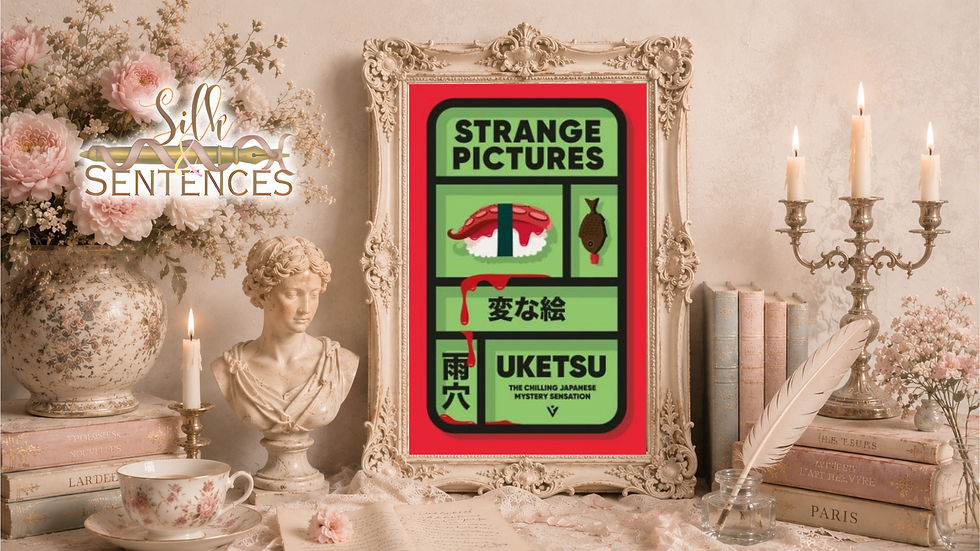
A white bird sits inside a black and thorny tree. Five drawings left by a woman who died during childbirth form a hidden image when placed together. A young boy covers part of his picture in heavy black strokes. A murdered art teacher leaves behind a landscape that appears to record his final moments.
Nothing in Strange Pictures stays as innocent as it first appears.
Written and illustrated by the anonymous Japanese author Uketsu and translated by Jim Rion, this unusual mystery is built around nine drawings. Every line, erasure, omission and alteration in perspective matters. The images aren't there to decorate the story or give it atmosphere. They contain evidence. Sometimes they preserve information that couldn't safely be spoken aloud. Sometimes they conceal it. Occasionally, they lead both the characters and the reader towards an answer that's technically correct but dangerously incomplete.
That contrast becomes increasingly important as four apparently separate mysteries begin to intersect. What first resembles a collection of eerie visual puzzles gradually reveals itself as the history of one family and the damage created by a woman who has confused love with possession.
Strange Pictures is clever, accessible and genuinely difficult to put down. Its prose is sparse and several characters are little more than instruments of investigation, but the construction's remarkably controlled. Each discovery forces the reader to return mentally to an earlier picture and question why its meaning once seemed so obvious.
The illustrations are the novel’s most distinctive feature, but their significance extends well beyond their novelty.
Readers are asked to scrutinise the drawings in the same way they might inspect a crime scene. Scale and position are important. The direction from which something is viewed is important. A smudge could cover an important detail, while the absence of a door or facial feature might reveal as much as anything visibly present.

Yuki’s five drawings depend upon sequence and layering. Yuta’s picture depends upon a mistaken assumption about the object being represented. Miura’s landscape depends upon light, location and time. Little A’s drawing depends upon the far less stable question of psychological interpretation.
Each puzzle ultimately requires a different kind of attention.
This prevents the visual device from becoming repetitive. Uketsu doesn't keep presenting the same trick in a slightly altered form. One picture acts as a warning. Another works as a map. Another exposes a forensic inconsistency. Another offers insight into its creator while also encouraging a catastrophic misreading of her character.
The drawings are truthful in ways the people interpreting them aren't always equipped to recognise. The problem is rarely that an image contains nothing meaningful. The problem is the confidence with which one possible meaning is accepted as the only one.
The rotating perspectives and nonlinear chronology allow Uketsu to conceal connections without making the book difficult to follow. Names change. Family relationships are initially obscured. Events separated by decades appear unrelated until a detail from one investigation enters another.
The structure is intricate, although the prose remains extremely direct. Jim Rion’s English translation is clear and economical, allowing the mechanics of the visual puzzles to remain easy to follow. The book moves quickly and moves on once a clue has been identified.
There's a degree of fair-play detection in the individual mysteries. The illustrations provide legitimate evidence, and an attentive reader might solve several of their secrets before the characters explain them. But the complete history depends upon identities and relationships that haven't yet been disclosed. The reader can participate in the investigation but can't reasonably reconstruct every part of it from the opening pages.
I didn't mind that balance. The pleasure came from testing an interpretation against each new piece of information rather than attempting to beat the novel to one final answer.
Uketsu is also very good at redirecting sympathy. Naomi’s section is the strongest example. Being placed inside her fear makes her emotionally convincing before she becomes morally comprehensible. We can understand that she feels endangered without accepting that the danger exists. We can recognise her attachment without calling it healthy.
That differentiation between emotional proximity and moral reliability is handled with considerable skill.

The construction is far richer than the characterisation.
Several characters function mainly as investigators who arrive to notice an inconsistency and explain its meaning. Sasaki and Kurihara are effective guides through the first puzzle, but they don't develop into especially memorable people. Other figures serve a similar practical purpose before disappearing from the foreground.
The prose is equally functional. Its plainness keeps an already complicated plot manageable, though readers drawn to elaborate language or sustained psychological intimacy may find it thin. The emotional weight is carried primarily by the revelations rather than by the writing at sentence level.
Uketsu also explains some solutions beyond the point at which they've become clear. The diagrams occasionally require careful guidance, but the repeated verbal clarification can make the reader feel as though the novel doesn't quite trust us to complete the inference.
A few coincidences and forensic manoeuvres also require generosity. The duplicated meal used to manipulate Miura’s estimated time of death is clever, for example, but it belongs to the heightened logic of puzzle fiction rather than the messier reality of criminal investigation.
None of this undoes the ingenuity of the book. It does, however, prevent its emotional impact from matching the precision of its design. I was absorbed by the way the mystery worked and disturbed by what it revealed, even when I wanted more depth from the people caught inside it.
Strange Pictures has a wonderfully simple invitation: look again.
Uketsu uses nine drawings to uncover a family history shaped by abuse, secrecy, medical sabotage, murder and a form of maternal love that's curdled into ownership. Each image changes as the surrounding information changes. What appeared to be a premonition becomes an accusation. What looked like a house becomes a grave marker. What seemed to represent protection becomes a portrait of captivity.
The writing is spare and the supporting characters lack the richness of the design around them. Several explanations could have been shorter, and the plot occasionally depends upon the reader accepting the heightened neatness of a carefully engineered puzzle.
Still, I found the novel absorbing. Its visual devices earn their place in the narrative, the separate investigations converge with impressive precision and Naomi’s distorted understanding of motherhood gives the mystery a far darker emotional centre than its clever premise initially promises.
Its most troubling idea has stayed with me: the truth may be present from the beginning without being recognised. People don't always overlook evidence because it's hidden.
Sometimes they overlook it because the comforting interpretation is easier to believe.

🖼️ Read this book if you love unconventional Japanese mysteries constructed around strange drawings and hidden meanings
✏️ Visual puzzles where smudges missing details altered perspectives and layered images become crucial evidence
🔎 Amateur investigations driven by unsettling discoveries overlooked clues and apparently unrelated mysteries
🐦 Psychological horror that turns children’s drawings pregnancy sketches and innocent family images into sources of unease
📄 Fragmented storytelling told through blog entries interviews investigations diagrams and reconstructed evidence
👁️ Visually immersive mysteries that invite readers to examine every line shape omission and change in orientation
🕯️ Dark family histories involving possessive motherhood childhood trauma medical sabotage secrecy and concealed violence
🧩 Fast-paced puzzle fiction in which each interpretation alters the evidence and draws four separate mysteries into one disturbing story
Book Details
Strange Pictures by Uketsu
Paperback ISBN
978-1805335399 — Pushkin Vertigo United Kingdom and international paperback edition published on 16 January
Hardcover ISBN
978-0063433090 — HarperVia United States hardcover edition published on 14 January 2025
eBook ISBN
978-1805335405 — Pushkin Vertigo United Kingdom and international eBook edition published on 16 January
Audiobook ISBN
978-1786587497 — 12Point Audio / Bonnier Books UK unabridged digital audiobook edition published on 3 July
Genre
Japanese Mystery Fiction; Horror Mystery; Psychological Thriller; Crime Fiction; Translated Japanese Fiction
SubgenreVisual Mystery; Puzzle Mystery; Psychological Horror; Domestic Horror; Mock-Documentary Fiction; Amateur-Sleuth Mystery; Family-Secret Thriller; Japanese Horror
Tropes / Literary ThreadsUnsettling drawings; hidden messages within pictures; visual clues; interconnected mysteries; amateur investigation; abandoned blog; child psychology; missing persons; concealed identities; nonlinear chronology.
Publisher
Futabasha — original Japanese-language edition
Series
Standalone novel published in Japanese as Hen na EA thematic companion to Uketsu’s Strange Houses and Strange Buildings rather than a numbered instalment in the Strange Houses series
Formats Available
Paperback; Hardcover; eBook; Digital Audiobook
Audiobook Narrator
Andrew Grace
Audiobook Length
Approximately 5 hours 17 minutes
Original Release Date
20 October 2022 — Futabasha original Japanese-language edition titled Hen na E
Australian Release Date
22 April 2025 — Pushkin Vertigo paperback edition distributed by Allen & Unwin
Page Count240 pages — Pushkin Vertigo paperback
Where to Buy Strange Pictures by Uketsu
📚 Amazon
Affiliate Disclosure
As an Amazon Associate, I earn from qualifying purchases. If you purchase through my Amazon affiliate links, I may receive a small commission at no additional cost to you. I also encourage supporting Australian booksellers such as QBD Books, independent booksellers, and self-published authors whenever possible.

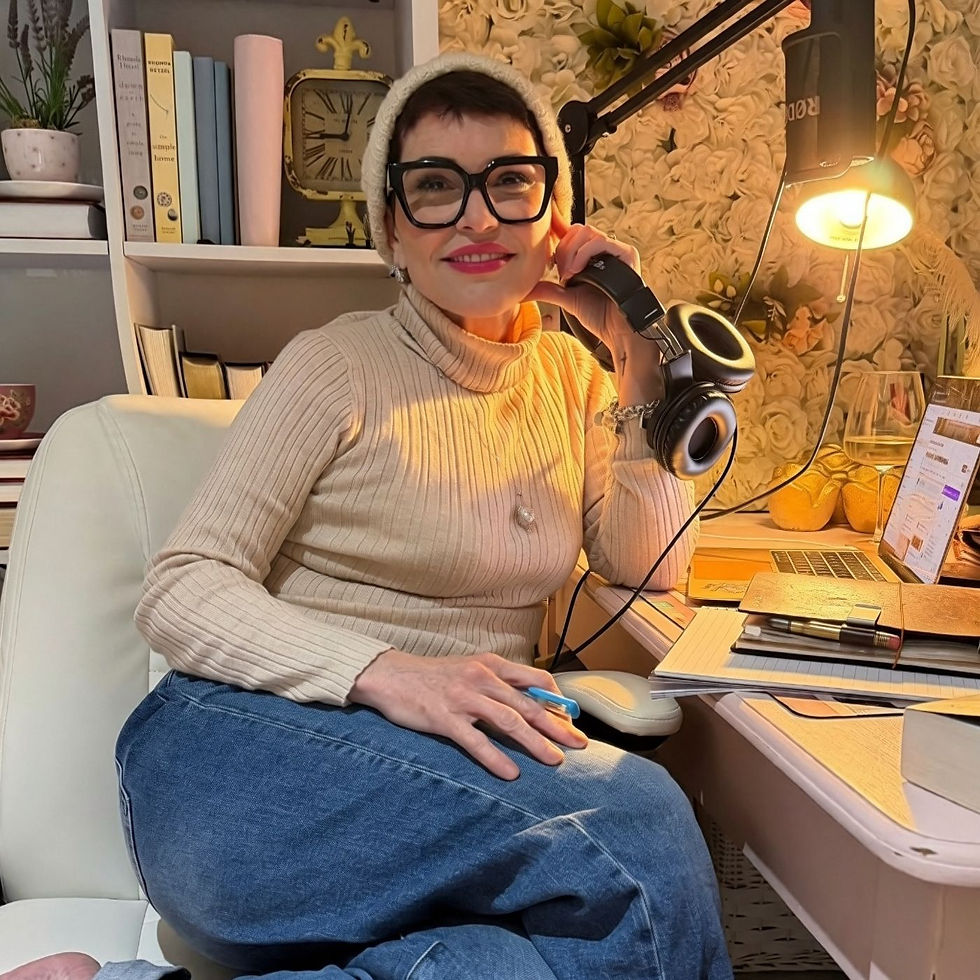
Danielle Robinson is a literary critic and writer whose
work explores literature through the
lens of atmosphere, memory, culture, and emotional experience. Holding a double degree in philosophy and theology, she combines academic insight with a deeply refined aesthetic sensibility shaped by more than three decades working across the creative industries as an internationally published, multi-award-winning makeup artist, fashion stylist, and interior stager.
She reads widely and rigorously, reading and reviewing more than 200 books each year as both an ARC reader and commissioned critic. Through Silk & Sentences, Danielle approaches literature as something immersive and lived with — not simply stories to consume, but works that shape the way we think, feel, and move through the world.
She writes from her semi-rural Queensland home, where she lives with Alex, her husband of 33 years, their dogs Oscar and Paige, and an ever-growing library of books.


Comments