

My youngest daughter assured me I would love Strange Houses. After all, she knows me! Knows I love a good mystery.
I was intrigued. Here is a Japanese mystery constructed around floor plans and the eerie possibilities hidden within domestic architecture, and exactly the kind of concept that should ordinarily appeal to me. There's something inherently disconcerting about a home whose proportions don't quite make sense: a room without a window, an inaccessible pocket of space, a corridor that appears to lead nowhere. Architecture can tell stories about the people who reside in it, and the suggestion that a building might reveal something its owners intended to conceal is an excellent foundation for psychological horror.
Unfortunately, Strange Houses doesn't trust that idea to generate unease on its own. Almost immediately, it takes a handful of architectural irregularities and turns them into an extraordinarily specific theory involving imprisonment, secret passages, ritualised murder and the calculated disposal of human remains.
I stopped reading at page 127.
By then, the problem wasn't only that I found the opening premise implausible. It was that the novel had established speculation masquerading as deduction as its primary method of storytelling. Each new floor plan produced another collection of elaborate suppositions, while the narrative treated the ability to imagine something dreadful as though it were evidence that the dreadful thing had occurred.
According to Kurihara, a child may could been confined inside the windowless bedroom. The hidden area might have formed part of a concealed passage through which the child could move around the house without being seen. Visitors could potentially have been encouraged to drink before being directed to the upstairs bathroom, where the child could attack them. Their bodies could conceivably have been dismembered and transferred through the building before being placed in a car in the garage.
There's even speculation that the family could have been operating some form of contract-killing business.
The difficulty isn't simply that this explanation is macabre. A horror novel's expected to be reasonably macabre. The difficulty is that practically nothing in the available evidence supports conclusions of this level of specificity.
A windowless bedroom doesn't establish that a child was imprisoned there. An unexplained gap on a plan doesn't prove that it contains a navigable passage. A separate bathroom doesn't suggest that visitors were murdered inside it. Storage near a garage isn't evidence of a system for transporting bodies. Even when considered together, these details can't reasonably tell us who lived in the house, how its rooms were used or whether a crime ever occurred there.
Kurihara occasionally reminds the narrator that he's only speculating. Yet this iteration does little to alleviate the problem because the novel continues to treat his conjectures as the basis of a serious investigation. The characters don't rigorously test ordinary explanations before entertaining extraordinary ones. Instead, they select the most sensational possible story and proceed as though its complexity makes it insightful.
There's an important difference between observation, inference and invention:
The floor plan contains an unexplained space. That's an observation.
The space could have been intentionally concealed. That's a possible inference.
The space allowed a captive child to murder intoxicated guests and facilitate the removal of their dismembered bodies. That is invention.
Strange Houses repeatedly collapses these three stages into one.
One particularly frustrating element is the way Kurihara’s professional knowledge lends his ideas an appearance of authority.
His architectural experience should allow him to identify unusual measurements, impractical layouts and inconsistencies between floors. It would also help him recognise whether a particular renovation would be structurally possible.
It can't tell him who occupied a room, whether a child was abused there or what motive the owners might have had for designing the building in a particular way.
The novel still allows architectural expertise to bleed into psychological and criminal certainty. Because Kurihara can show that two spaces align, his increasingly outlandish interpretation of that alignment is made to sound almost forensic.
But expertise has boundaries. A doctor can recognise an injury without knowing who caused it. An archaeologist might identify that a structure was altered without being able to determine the private intentions of the person who altered it. An architectural designer may recognise dead space without being able to reconstruct an entire murder operation from it.
The most convincing version of this story would have allowed Kurihara to be wrong, or at least substantially wrong. His theory could have revealed more about his own macabre imagination than about the occupants of the house. The characters’ eagerness to impose a terrible story upon ambiguous spaces might itself have become the source of the horror.
Instead, the novel depends upon us accepting his imagination as insight.
The floor plans are the book’s most successful feature.
They invite us to pause, turn back through the pages and compare the position of walls and rooms. They offer a tactile form of participation that conventional prose can't replicate. As readers, we're not simply told that something is strange; we're shown the plan and encouraged to locate the irregularity ourselves.
There's also something psychologically exhilerating about transforming a floor plan into an object of dread. Plans ordinarily promise clarity. They reduce a home to ordered lines, dimensions and labels. We assume that looking at planswill help us understand a building.
Uketsu flips that anticipation. The more closely the characters look, the less secure the house becomes. Walls suggest concealment. Empty spaces become threatening. The home stops being a sanctuary and starts to resemble a mechanism.
As a piece of visual design, this is genuinely effective.
The problem is that the plans create the impression of evidence without supplying sufficient evidence to support the conclusions drawn from them. They make the characters’ theories look demonstrable because those theories can be traced across a diagram. Yet spatial possibility isn't proof of historical use. Showing how someone could theoretically move through a concealed passage doesn't establish that the passage existed or that anyone used it to commit murder.
The floor plans therefore function more successfully as horror props than as clues.
Much of the book’s popularity makes sense when considered in relation to its beginnings as online content.
The writing is extremely accessible. Chapters are short. The visual material breaks up the text. The conversational structure allows information to be delivered quickly, and each new anomaly produces another narrative hook. It's a book designed to make the reader wonder what disturbing possibility will be proposed next.
That immediacy will work wonderfully for some readers. Anyone approaching the book as a piece of creepypasta-style entertainment may be more willing to surrender to its escalating possibilities. There's definitely pleasure in the simple act of inspecting the diagrams and trying to imagine why anyone would design such weird rooms.
But what's effective in short-form horror doesn't necessarily survive the demands of a novel.
A viral video needs a compelling proposition. A mystery novel needs development, credible investigation, characterisation and some form of internal logic. By the point at which I stopped reading, Strange Houses had continued to expand its central proposition without making its reasoning more persuasive.
The dialogue's largely expository. The narrator has little interior life and primarily exists to ask questions or receive explanations. Kurihara operates less as a fully realised character than as a machine for producing theories. New people and new plans enter the narrative principally to provide access to further layers of information.
I found myself observing the mechanism rather than becoming immersed in the mystery.

Strange Houses has an excellent visual hook and an instinctive understanding of how domestic spaces can be made uncanny. Its floor plans are unusual, memorable and immediately engaging. The book's short, fast-moving and likely to appeal to readers who enjoy internet horror, mock-documentary storytelling and mysteries built around unusual physical objects.
Yet its presentation is more ingenious than its reasoning because the novel consistently mistakes what can be imagined for what can be inferred. Architectural peculiarities become evidence of extremely specific crimes without the necessary intermediate steps. Professional expertise is used to give speculative storytelling the appearance of deduction, while later developments seem designed to confirm theories that were never adequately supported.
The result is a mystery that asks the reader to marvel at its conclusions without first earning their belief.
I wanted the strange spaces to remain strange long enough to become genuinely frightening. Instead, the book explained them through such elaborate assumptions that the mystery began to feel less like an investigation than a story being invented in front of me.
For some readers, the novelty of that story will be enough. For me, the foundation was simply too unstable to support the house built upon it.

🏠 Read this book if you love unconventional Japanese mysteries built around peculiar houses and disturbing floor plans
📐 Architectural puzzles featuring hidden spaces unusual room layouts and designs that suggest sinister secrets
🔎 Amateur investigations driven by speculation strange coincidences and increasingly elaborate theories
🚪 Domestic horror that transforms ordinary walls corridors bedrooms and bathrooms into sources of unease
📄 Mock-documentary storytelling told through conversations diagrams interviews letters and reconstructed evidence
👁️ Visually immersive mysteries that invite readers to study floor plans and search for overlooked details
🕯️ Dark family histories involving inherited trauma coercion superstition greed and concealed violence
🧩 Fast-paced puzzle fiction where each apparent answer leads to another house another theory and an even stranger possibility
Book Details
Strange Houses by Uketsu
Paperback ISBN
978-1805335375 — Pushkin Vertigo United Kingdom and international paperback edition published on 3 July 2025
Hardcover ISBN
978-0063468085 — HarperVia United States hardcover edition published on 3 June 2025
eBook ISBN
978-1805335382 — Pushkin Vertigo United Kingdom and international eBook edition published on 3 July
Audiobook ISBN
978-1786587503 — 12Point Audio / Bonnier Books UK unabridged digital audiobook edition published on 3 July
Genre
Japanese Mystery Fiction; Horror Mystery; Psychological Thriller; Crime Fiction; Translated Japanese Fiction
Subgenre
Architectural Mystery; Domestic Horror; Puzzle Mystery; Mock-Documentary Fiction; Visual Mystery; Amateur-Sleuth Mystery; Family-Secret Thriller; Japanese Horror
Tropes / Literary Threads
Unsettling floor plans; hidden rooms; unexplained architectural spaces; amateur investigation; eccentric expert; houses concealing secrets; presumed secret passages; missing persons; dismembered bodies; unreliable testimony; concealed identities
Publisher
Asukashinsha — original Japanese-language edition
Series
Strange Houses / Hen na Ie — Book One
Followed by Strange Buildings — the English-language edition of Hen na Ie 2
Formats Available
Paperback; Hardcover; eBook; Digital Audiobook
Audiobook Narrator
Andrew Grace
Audiobook Length
Approximately 3 hours 29 minutes
Original Release Date
20 July 2021 — Asukashinsha original Japanese-language edition titled Hen na Ie
Australian Release Date
2 September 2025 — Pushkin Vertigo paperback edition distributed by Allen & Unwin
Page Count
208 pages — Pushkin Vertigo paperback
Where to Buy Strange Houses by Uketsu
📚 Amazon
Affiliate Disclosure
As an Amazon Associate, I earn from qualifying purchases. If you purchase through my Amazon affiliate links, I may receive a small commission at no additional cost to you. I also encourage supporting Australian booksellers such as QBD Books, independent booksellers, and self-published authors whenever possible.

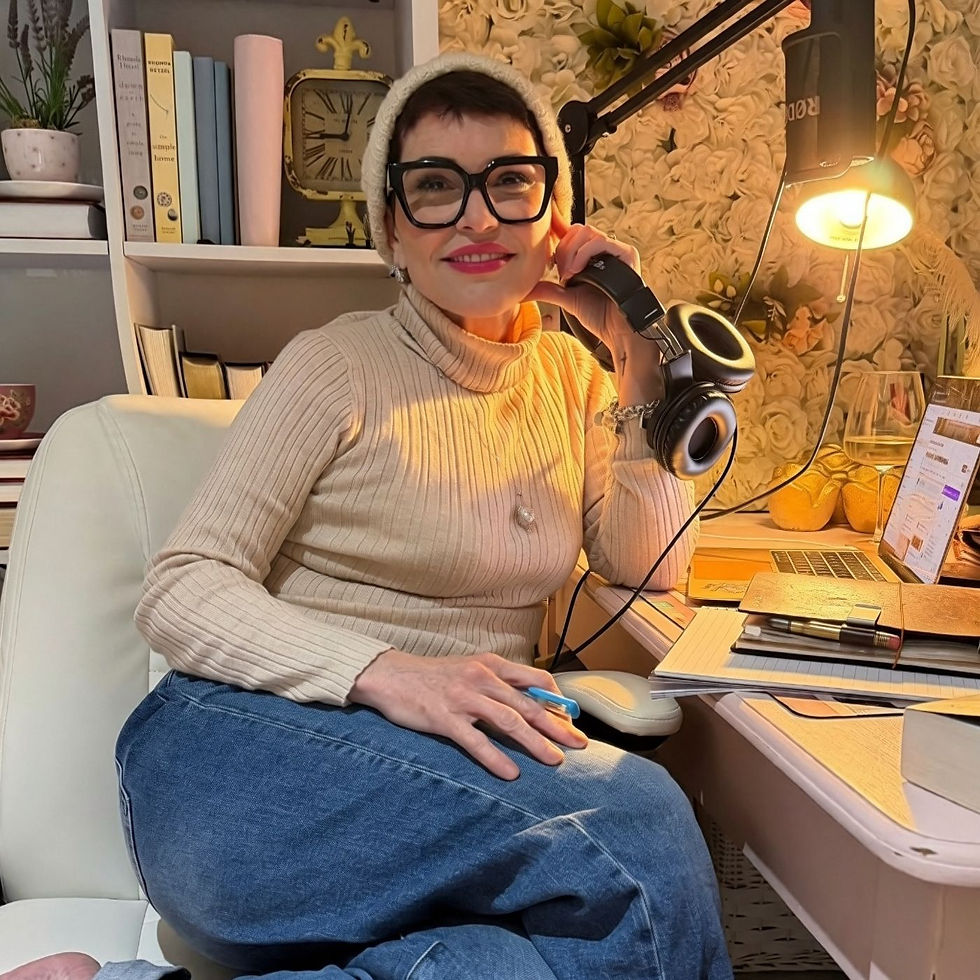
Danielle Robinson is a literary critic and writer whose
work explores literature through the
lens of atmosphere, memory, culture, and emotional experience. Holding a double degree in philosophy and theology, she combines academic insight with a deeply refined aesthetic sensibility shaped by more than three decades working across the creative industries as an internationally published, multi-award-winning makeup artist, fashion stylist, and interior stager.
She reads widely and rigorously, reading and reviewing more than 200 books each year as both an ARC reader and commissioned critic. Through Silk & Sentences, Danielle approaches literature as something immersive and lived with — not simply stories to consume, but works that shape the way we think, feel, and move through the world.
She writes from her semi-rural Queensland home, where she lives with Alex, her husband of 33 years, their dogs Oscar and Paige, and an ever-growing library of books.


Comments