
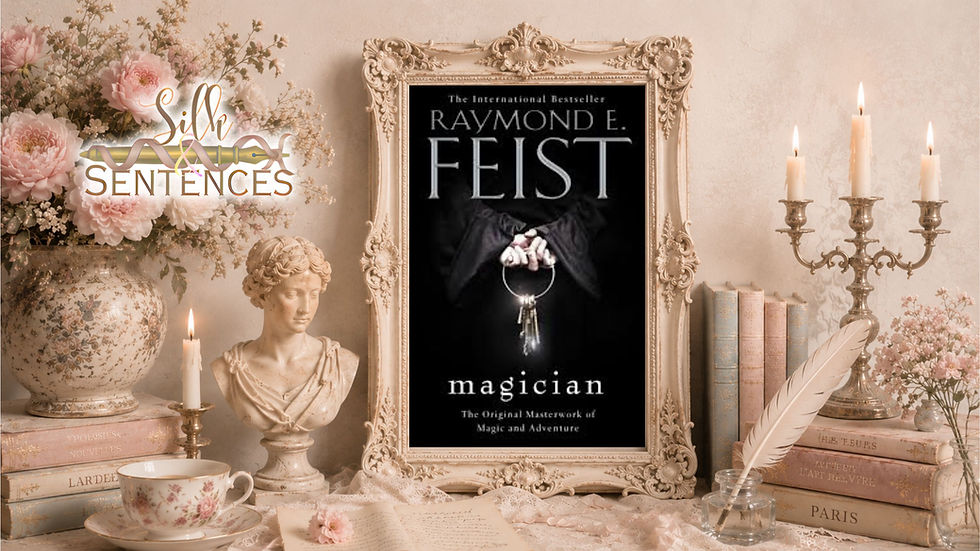
Every genre has its landmark novels. The books that quietly reshape everything that follows. Readers discover them decades later, only to wonder why they feel so familiar, forgetting that they're familiar because generations of writers have been borrowing from them ever since. Raymond E. Feist's Magician is one of those books.
First published in 1982, it arrived during a period when fantasy was still living in Tolkien's shadow. Elves, dwarves, dragons and young heroes destined for greatness had become the language of the genre, and it would have been easy for Feist to write another comfortable quest through well-trodden territory. Instead, he introduced something far more ambitious: two worlds, each with its own history, politics and culture, colliding through magical rifts. More than forty years later, that ambition is still evident on every page.
The story begins in the frontier stronghold of Crydee, where two orphaned boys, Pug and Tomas, stand at the threshold of adulthood. Pug, awkward and often underestimated, becomes apprentice to the kingdom's magician, while Tomas trains as a soldier. Their lives change irrevocably when warriors from another world invade Midkemia, drawing both friends into a conflict that stretches far beyond anything either of them could have imagined. From that point, their journeys diverge.
Pug's path carries him across worlds, from apprentice to slave, from student to one of the most powerful magicians either civilisation has ever known. Tomas follows a darker, stranger road, inheriting the legacy of the ancient Valheru and gradually becoming something more legend than man.
Although both stories are compelling, it was Pug's that completely captured my attention. His growth never feels effortless. He isn't gifted with instant brilliance or protected by plot armour. Instead, he learns through failure, adapts to circumstances beyond his control and repeatedly finds himself rebuilding his understanding of both magic and the world itself.
Watching that progression unfold over the course of the novel is immensely satisfying.
Yet for me, the greatest surprise wasn't the magic. It was the Tsurani. Fantasy has a long history of presenting invading forces as faceless enemies whose only purpose is to threaten the heroes. Feist chooses a far more interesting path. The Tsurani arrive as conquerors, but they are also scholars, politicians, nobles, soldiers and families bound by a rigid code of honour. Their customs often appear bewildering through Midkemian eyes, but as Pug becomes immersed in their society, the novel asks readers to reconsider the assumptions they've made about who the villains really are.
That willingness to explore culture instead of caricature gives Magician a depth that feels surprisingly modern. Long before fantasy embraced morally complex empires and competing perspectives, Feist was already suggesting that conflict often grows from misunderstanding as much as malice.
The world-building is equally impressive. Finding out that Midkemia originated as a tabletop role-playing world explains why it feels so expansive. Every kingdom appears to have its own history, every culture its own traditions, and every journey hints at places beyond the edges of the map. The world rarely feels as though it exists solely for the benefit of its protagonists. Life continues beyond the immediate story, and that gives the novel a remarkable sense of authenticity.
It's easy to see why Magician became such an influential work. Many of the elements modern fantasy readers now take for granted—expansive secondary worlds, political conflict, young protagonists discovering extraordinary abilities and stories spanning years rather than weeks—are woven together here with remarkable confidence.
Ironically, that influence creates one of the novel's greatest challenges for contemporary readers.
Because so many authors have drawn inspiration from Magician, parts of it inevitably feel familiar. That's not a criticism of Feist's originality; it's evidence of just how deeply this novel shaped the genre. Like Dracula or The Lord of the Rings, its ideas have become part of fantasy's shared vocabulary.
That said, Magician isn't immune to its age. The pacing is noticeably slower than much of today's epic fantasy, particularly through extended sections of travel and military movement. Feist is in no hurry to reach his destination, and while that patience contributes to the novel's enormous sense of scale, there were moments when I found myself wishing the narrative would move a little more decisively.
The prose is another area where time has left its mark. It serves the story well enough but rarely elevates it. There are passages that rely heavily on exposition, occasional repetition and moments where events are described rather than experienced. Modern fantasy has become considerably more character-driven, and readers coming directly from authors like Robin Hobb, Joe Abercrombie or Brandon Sanderson may notice the difference immediately.
I also found Tomas' storyline less emotionally engaging than Pug's. His transformation is fascinating in concept, but because so much of it is tied to the ancient power he inherits, it occasionally feels as though the mythology is driving the character rather than the other way around. Pug, by comparison, remains deeply human throughout his extraordinary journey.
None of those observations diminish what Magician accomplishes. Reading it today feels a little like visiting a beautifully preserved historic building. There are modern designs that are sleeker, more intricate and perhaps technically more accomplished, but standing inside the original allows you to appreciate just how much of what followed was built upon its foundations.
Fantasy has evolved enormously since 1982. It's become darker, more psychologically complex and increasingly ambitious in its structure. Yet Magician reminds us that the genre's greatest strength has never been complexity for its own sake. It's always been its ability to transport us somewhere extraordinary and make us believe, if only for a few hundred pages, that impossible things might exist just beyond the horizon.
Magician may not be flawless, but its reputation is richly deserved. It remains an absorbing adventure, an imaginative feat of world-building and an important chapter in the history of modern fantasy. For readers willing to embrace a more measured pace and a classic style of storytelling, it offers an experience that is both nostalgic and enduring.
Some classics are remembered because they were first. Others because they are still worth reading.
Happily, Magician is both.
Rating: ★★★★☆
Book Details
Magician — Raymond E. Feist
Paperback ISBN
978-0007488728 (HarperVoyager edition; varies by region and whether published as a single volume or split edition)
Hardcover ISBN
978-0385198783 (Original Doubleday hardcover; varies by edition and region)
eBook ISBN
978-0007385188 (HarperVoyager eBook edition; varies by retailer and region)
Genre
Epic Fantasy; High Fantasy; Adventure Fantasy; Adult Fantasy
Subgenre
Sword and Sorcery; Coming-of-Age Fantasy; Portal Fantasy; Military Fantasy; Science Fantasy; Classic Fantasy
Tropes / Literary Threads
Chosen one; coming of age; orphan protagonist; mentor and apprentice; magical education; hidden power; friendship; ancient prophecy; portal between worlds; war between kingdoms; found family; political intrigue; reluctant hero; dual protagonists.
Publisher
Doubleday (Original Edition)
HarperVoyager (Current UK editions)
Series
The Riftwar Saga
(Book One of the Riftwar Cycle)
Series Order
Magician
Silverthorn
A Darkness at Sethanon
Formats Available
Paperback; Hardcover; eBook; Audiobook
Audiobook Narrator
Peter Joyce (many editions)
Nicholas Guy Smith (Author's Preferred Edition; varies by region)
Release Date
1982
(Author's Preferred Edition published 1992)
Page Count
Approximately 680–850 pages
(varies considerably depending on edition and whether published as one volume or split into Magician: Apprentice and Magician: Master)*
Setting
Midkemia and Kelewan
Primary Setting Details
The story begins in the frontier Duchy of Crydee on the world of Midkemia before expanding across kingdoms, ancient forests, mountain strongholds and ultimately the alien world of Kelewan. Castles, magical academies, battlefields, royal courts and forgotten civilisations provide the backdrop to an epic conflict between two worlds connected by mysterious magical rifts. The expansive setting explores warfare, diplomacy, cultural identity, political power and the responsibilities that accompany extraordinary ability.
Main Characters
Pug
An orphan raised in Crydee who becomes apprentice to the magician Kulgan. Initially dismissed as clumsy and unremarkable, Pug discovers extraordinary magical potential that ultimately transforms him into one of the most powerful magicians in either world.
Tomas
Pug's lifelong friend and an apprentice soldier. After discovering ancient Valheru armour, Tomas gradually becomes intertwined with the legacy of a legendary warrior race, forcing him to balance his humanity with immense inherited power.
Kulgan
The wise court magician of Crydee who recognises Pug's potential and becomes his first mentor.
Prince Arutha conDoin
The intelligent and courageous Prince of Crydee whose leadership becomes increasingly important as the Riftwar escalates.
Martin Longbow
An exceptional ranger and archer whose loyalty and skill prove invaluable throughout the war.
Macros the Black
A mysterious and immensely powerful magician whose knowledge of the Rift and its origins shapes the wider conflict.
The Tsurani
The disciplined civilisation from Kelewan whose invasion of Midkemia drives the novel's central conflict. Their complex political structures, honour-based society and cultural traditions become one of the novel's greatest strengths.
Cultural & Literary Influences
Traditional European mythology; medieval history; tabletop role-playing games; Arthurian legend; Japanese feudal culture; military history; heroic mythology; classic quest narratives; political fantasy; portal fantasy.
Major Themes
Friendship and loyalty; identity and transformation; destiny versus choice; the burden of power; cultural misunderstanding; war and its consequences; leadership; sacrifice; mentorship; political responsibility; honour; prejudice; belonging.
Content Warnings
Fantasy violence; warfare; battle scenes; death; slavery; imprisonment; torture; grief; loss; discrimination; mild romantic content; occasional strong language.
Comparable Titles
The Lord of the Rings
The Belgariad
The Wheel of Time
Memory, Sorrow, and Thorn
The Farseer Trilogy
The Name of the Wind
The Will of the Many
The Dragonbone Chair
Ideal Readers
Readers who enjoy classic epic fantasy, expansive world-building, richly developed secondary worlds, military fantasy, coming-of-age adventures, magic systems, political intrigue, immersive fantasy series and foundational works that helped shape the modern fantasy genre.
Rating
★★★★☆
(4 Stars)
Magic / Action Level
⚔️⚔️⚔️⚔️⚔️ / 5
Large-scale battles, magical duels, political intrigue and world-spanning adventure dominate the novel. While action is plentiful, the story also devotes considerable time to character growth, cultural exploration and the gradual development of its expansive fantasy world.
Where to Buy Magician by Raymond E. Feist
📖 Amazon Australia (Affiliate)https://www.amazon.com.au/s?k=Magician+Raymond+E.+Feist
📚 QBD Bookshttps://www.qbd.com.au/search?keywords=Magician%20Raymond%20E.%20Feist
📕 Dymockshttps://www.dymocks.com.au/search?query=Magician%20Raymond%20E.%20Feist
📘 Booktopiahttps://www.booktopia.com.au/search.ep?keywords=Magician+Raymond+E.+Feist
🎧 Audible Australiahttps://www.audible.com.au/search?keywords=Magician+Raymond+E.+Feist
🍎 Apple Bookshttps://books.apple.com/au/search?term=Magician%20Raymond%20E.%20Feist
Affiliate Disclosure
As an Amazon Associate, I earn from qualifying purchases. If you purchase through my Amazon affiliate links, I may receive a small commission at no additional cost to you. I also encourage supporting Australian booksellers such as QBD Books, Dymocks and Booktopia whenever possible.


Danielle Robinson is a literary critic and writer whose work explores literature through the lens of atmosphere, memory, culture, and emotional experience. Holding a double degree in philosophy and theology, she combines academic insight with a deeply refined aesthetic sensibility shaped by more than three decades working across the creative industries as an internationally published, multi-award-winning makeup artist, fashion stylist, and interior stager.
She reads widely and rigorously, reading and reviewing more than 200 books each year as both an ARC reader and commissioned critic. Through Silk & Sentences, Danielle approaches literature as something immersive and lived with — not simply stories to consume, but works that shape the way we think, feel, and move through the world.
She writes from her rural Queensland home, where she lives with Alex, her husband of 33 years, their dogs Oscar and Paige, and an ever-growing library of books.

Comments